How Much Spanish Should You Know Before Traveling?
Last Updated: February 2026
Written by Abraham Arechiga-Arias
Cofounder at Spanish55

Most adults preparing for travel do not ask whether they should learn Spanish.
They ask how much is enough.
Enough to feel confident.
Enough to avoid hesitation.
Enough to participate rather than observe.
The answer depends entirely on what kind of traveler you are.
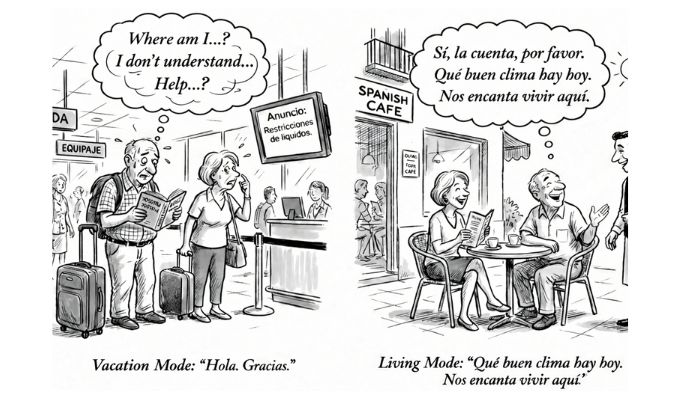
If your goal is to navigate airports, order meals, and manage logistics, very little Spanish is technically required. But if your goal is to engage in real conversations, understand nuance, and experience a destination relationally rather than transactionally, preparation matters.
In a recent feature in Luxury Travel Magazine, we explored why language planning is becoming part of intentional travel for adults who value depth over spectacle. Here, we’ll answer the practical question: how much Spanish is actually enough?
Is It Worth Learning Spanish Before Traveling?
Yes, if connection matters to you.
Travel without language rarely prevents you from moving through a place. But it often limits the depth of your experience. Conversations stay short. Humor goes unnoticed. Cultural references pass by quietly.
When adults arrive with conversational Spanish already in place, the tone of the trip changes immediately. They speak sooner. They understand more. They feel less self-conscious. Locals respond differently.
Even beginner conversational ability expands access in ways that reservations and itineraries cannot.
You do not need flawless accuracy.
You need fluency. The confidence to keep speaking, even imperfectly.
Conversational fluency does not mean speaking perfectly.
It means you are no longer assembling sentences word by word in your head. You are thinking in ideas rather than translating from English. You can respond in real time without mentally checking every verb ending before you speak.
You do not need flawless accuracy.
You need fluency. The confidence to keep speaking, even imperfectly.
Practically, this means being able to introduce yourself naturally, describe past experiences and future plans, ask thoughtful follow-up questions, and understand responses delivered at normal conversational speed. It also means having enough control over the most common verb tenses that communication flows, even when it is not grammatically perfect.
A useful benchmark is this: if you can sustain a 10 minute back-and-forth conversation entirely in Spanish, asking questions, responding spontaneously, and clarifying when needed without switching to English, you are entering your trip prepared.
This level rarely happens by accident.
Adults do not typically reach conversational fluency through occasional exposure or memorized phrases. It develops through consistent, guided conversation where mistakes are corrected early, patterns are reinforced deliberately, and each session builds on the last.
Below this level, exchanges tend to remain brief and predictable. You can navigate, but you cannot expand. You can respond, but you cannot guide the direction of the conversation. The interaction stays functional rather than dynamic.
The shift from accuracy-focused speaking to fluency-focused speaking is subtle, but once you experience it, it changes how you travel.
Is Immersion in a Spanish-Speaking Country Enough?
Immersion exposes you to language. It does not organize it.
Many travelers assume that being surrounded by Spanish will automatically accelerate progress. The logic seems sound: move to a Spanish-speaking country, and fluency will follow.
In practice, immersion alone often produces survival-level communication. You learn to order. You greet politely. You navigate daily logistics. You become comfortable managing the essentials.
But comfort is not the same as fluency.
It is not uncommon to meet people who have lived in a Spanish-speaking country for years and still hesitate to speak confidently. Some interact almost exclusively within English-speaking circles. Others remain functional but never move beyond predictable exchanges.
Immersion works. But it works best when paired with intention.
Language acquisition requires more than exposure. It requires repetition, correction, and a willingness to tolerate mistakes without retreating into silence. Adults often face additional barriers: fear of sounding incorrect, fear of slowing the conversation, or fear of being judged. Without structure, those fears quietly shape behavior.
When you are abroad without preparation, it is easy to fall into what feels comfortable. You choose restaurants where English is spoken. You rely on bilingual friends. You avoid conversations that might stretch you. Progress slows not because you lack opportunity, but because you lack momentum.
Structured preparation before arrival changes this dynamic.
When you have already built conversational confidence, immersion becomes refinement rather than initiation. You arrive prepared to engage. You seek out conversations instead of avoiding them. You push through small mistakes because fluency, not perfection, is the goal.
Preparation gives immersion direction.
It ensures that exposure turns into growth rather than familiarity. And it helps you avoid the quiet plateau that so many long-term residents experience when exposure is present but structure is not.
Immersion is powerful but it works best when you arrive ready to use it.
How Long Does It Take to Reach Conversational Spanish?
For English-speaking adults starting from beginner level, conversational readiness typically requires about 7 months of twice-weekly private instruction.
This timeline reflects how language settles in adults. Grammar must be internalized gradually. Listening must adapt to natural speed. Confidence develops through repetition and correction over time.
Twice-weekly sessions create the rhythm necessary for momentum. Less frequent instruction often slows progress. Sporadic effort rarely produces stability.
Conversational Spanish is built through consistency.
What Is the Most Effective Way to Prepare?
For English-speaking adults starting from zero, conversational readiness does not happen in a few weeks. It builds steadily.
In practical terms, most adults need between 60 and 120 hours of structured private instruction to reach what the CEFR framework calls an A1 level of comfort interacting in Spanish.
A1 is often misunderstood as “just the first level.” In reality, a solid A1 foundation is powerful. At this stage, you are able to introduce yourself confidently, ask and answer simple but meaningful questions, navigate everyday situations, and sustain short conversations without freezing.
That is not mastery. But it is real communication.
For many adults, reaching that level of usable fluency typically requires about 7 months of twice-weekly private instruction. This timeline reflects how language actually settles in adults. Grammar internalizes gradually. Listening adjusts to natural speed. Speaking confidence develops through repetition and guided correction.
Twice-weekly sessions create enough frequency to maintain momentum without overwhelming a busy schedule. Less frequent instruction often slows progress because each lesson becomes a reset rather than a continuation.
Conversational Spanish is not built through intensity alone. It is built through consistency.
And when that consistency is in place, the shift from hesitation to fluency becomes noticeable.
What Level of Spanish Is Needed for Spain or Latin America?
This is one of the most common practical questions adults ask:
Do you need Spanish in Spain or Latin America?
The honest answer depends on how you plan to travel.
In major cities such as Madrid, Barcelona, Mexico City, or Buenos Aires, English may be available in hotels, high-end restaurants, and tourist-facing environments. You can often navigate comfortably without speaking Spanish.
But the moments that define a trip rarely happen in those spaces.
They happen in neighborhood cafés, family-run restaurants, local markets, private tours, small galleries, and everyday interactions. In those environments, English becomes less reliable. And even when it is available, the dynamic changes.
At a minimum, reaching a strong A1 or early A2 level, meaning you can handle everyday conversations with confidence, dramatically expands your experience.
At that level, you can:
- Ask questions beyond logistics
- Understand most responses at normal speed
- Express preferences and opinions
- Clarify misunderstandings without switching to English
You may still make mistakes. That is normal.
What changes is your ability to stay in the conversation.
In Spain, Mexico, Colombia, Argentina, Costa Rica, or elsewhere in Latin America, conversational Spanish allows you to understand tone, humor, and cultural references that are otherwise lost. You respond without mentally translating each sentence. You engage rather than observe.
Language does more than facilitate communication. It signals respect. It shows effort. It invites openness.
When you speak Spanish, even imperfectly, you shift from being a visitor who is accommodated to a participant who is welcomed.
How Do You Know If You’re Ready — And What Is the Best Way to Start?
Readiness does not feel perfect. It feels steady.
You can express complete thoughts without assembling sentences word by word. You understand most responses at natural conversational speed. When you make a mistake, you adjust and continue rather than withdrawing from the conversation.
You are not searching for every word. You are staying in the exchange.
Confidence replaces hesitation. That is conversational fluency.
So what is the best way to start if your goal is to arrive ready?
Clarity.
Before guessing how long it will take or what level you need, you need an accurate assessment of where you are now and a structured plan based on your timeline.
Book a free trial zoom lesson with a private Spanish tutor at Spanish55. During that free lesson, you will receive a personalized level evaluation, clear expectations about what reaching conversational readiness will require, and a practical roadmap aligned with your travel plans.
If you are serious about experiencing your destination beyond surface-level interaction, preparation is not optional.
It is the advantage. Start there.
Thinking beyond a short trip?
If you're planning to spend extended time in a Spanish-speaking country, or even retire abroad, your language needs will be very different.
Read our article: Learn Spanish for Living or Retiring Abroad