Relearning Spanish When You Grew Up Around It but Never Spoke It
Last Updated: March 2026
Written by Carlos A. Rubí, Senior Digital Communications Strategist & Language
Education Writer at Spanish55
Relearning Spanish as a Heritage Speaker: Key Insights
-
Many adults who grew up around Spanish already understand it—the real challenge is building confidence and speaking ability, not starting from zero.
-
The need to speak Spanish often becomes more meaningful in adulthood, especially in family, cultural, and professional situations.
-
Passive learning (apps, podcasts, YouTube) reinforces what you understand but does not help you speak with confidence.
-
Real progress begins in a safe, one-on-one environment where you can practice speaking without pressure or judgment.
-
Consistent, guided conversation is the fastest way to turn understanding into real communication skills.
-
Success is not about perfection, it’s about feeling comfortable, confident, and able to participate in real conversations.
Spanish has always been close for many heritage speakers. It was heard at home, spoken by family members, and woven into culture and identity. Yet it was never something they were taught to speak themselves.
For a long time, that doesn’t feel like a problem.
Understanding bits and pieces feels sufficient. Family adapts. Life moves forward. The absence of Spanish feels normal, even invisible.
Then something changes.
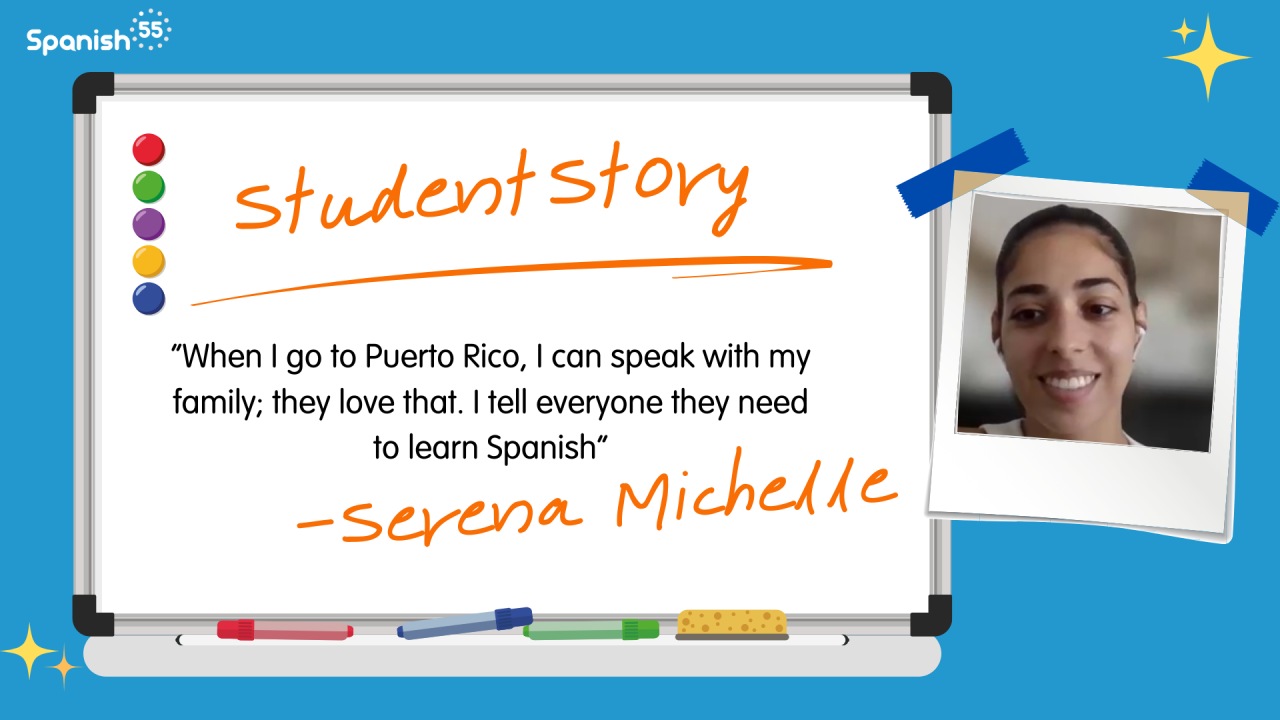
At Spanish55, we’ve worked with many adults relearning Spanish. Serena is one of them. She grew up surrounded by Spanish but was never taught to speak it. Today, after working one-on-one with a Spanish55 tutor, she speaks Spanish confidently and comfortably in real conversations.
Her story reflects what happens when second or third-generation Americans are given the right conditions to reclaim a language that was always part of them.
What It’s Like to Grow Up Around Spanish but Never Learn to Speak It

For many heritage speakers, Spanish was present everywhere except where it mattered most: in their own voice. It existed in the family, but not as something they were guided to use themselves.
Serena describes this starting point clearly:
“Spanish was always present in my family, but it was never passed down to me. My whole family speaks Spanish, but I wasn’t taught.”
Spanish did not disappear. It simply skipped a generation. As a child, that absence rarely feels like loss. It feels normal.
Why Not Speaking Spanish Often Doesn’t Feel Urgent Until Adulthood
In early life, not speaking Spanish often doesn’t register as a problem. Partial understanding creates the sense that nothing is missing.
“When I was younger, I didn’t really think much about it. I understood enough, so it didn’t feel like a big problem.”
This stage can last years. Family members adjust. Conversations move on. Life does not yet demand full participation.
The Emotional Impact of Understanding Spanish but Not Being Able to Speak It
Over time, the gap becomes harder to ignore.
As heritage speakers move through adulthood, Spanish stops being something they simply “don’t speak” and becomes something they actively feel missing. The language starts to show up in moments that matter, conversations they can’t fully join, questions they hesitate to answer, parts of themselves they struggle to express. What was once abstract becomes personal, and the distance from Spanish begins to feel heavier.
For Serena, that shift became increasingly uncomfortable. “As I got older, it started to bother me more” she says. “I felt embarrassed when I couldn’t respond. It made me feel like I was on the outside.”
Spanish becomes about belonging, not ability.
What Motivates Adults to Finally Relearn Spanish
For many adults, the turning point comes when Spanish starts to matter beyond personal frustration.
For Serena, that moment is family.
“It’s really important for me to learn Spanish for the sake of my family,” she says. “I have a son, and I want to teach him. It’s a life goal that I have.” You can hear the weight behind it. This isn’t casual motivation.
But family is only one kind of catalyst that prompts this shift.
For others, the motivation comes from relationships. Struggling to fully participate in conversations at gatherings. Always listening, rarely speaking.
For some, it shows up professionally. Being seen as the bilingual one at work, yet feeling exposed when asked to speak Spanish confidently. Carrying the pressure of being “supposed to be” fluent because of background or last name.
And for many, it’s internal. A growing sense of not being enough. Of living close to a language and culture without fully belonging to it.
At Spanish55, we see these moments as the point where people are ready to move forward with intention.
Why Apps and Self-Study Don’t Work for Adults Who Grew Up Around Spanish
When heritage speakers decide to relearn Spanish, most don’t start by looking for an online Spanish tutor for adults.
They start quietly.
YouTube videos. Podcasts. Apps. Passive exposure that feels safe and private. These options make sense emotionally. There’s no risk of being judged. No one listening when words don’t come out. No need to explain why an adult who grew up around Spanish still struggles to speak it.
For many second-generation Americans, there’s also an unspoken belief underneath all of this: if Spanish was around growing up, they should already know how to speak it.
So they choose tools that let them stay invisible.
The problem is that these options don’t address the real issue. Heritage speakers usually understand most of what they hear. Passive input confirms what they already know, but it doesn’t move them forward.
What’s missing is not exposure. It’s practice.
Serena reached this point after trying to figure it out on her own. At first, it felt like the obvious path, something she should be able to do quietly and independently. But that approach quickly ran into its limits.
“I’m just gonna go out and learn on my own,” she recalls.
“But I found it difficult to teach myself.”
Most times, people who grew up around Spanish don’t avoid tutors because they lack motivation. They avoid them because they assume tutoring is for beginners or non-native speakers. In reality, they are not beginners. They are learners with a unique starting point who need guided, spoken practice in a safe setting to build confidence.
How Expectations From Other Spanish Speakers Can Hurt Confidence
In our experience at Spanish55, many people who grew up around Spanish end up practicing it in environments where expectations don’t match their actual ability.
For Serena, that experience left a clear impression. “I had a really bad experience,” she recalls. “It felt really aggressive.”
Among Hispanics in the U.S., there’s often an assumption that Spanish should come naturally. When someone hesitates, patience wears thin, corrections come faster, and the pressure builds.
What feels aggressive is often not intentional, but it shuts confidence down. Instead of learning, people tend to shut down.
Why a Safe, One-on-One Environment Matters for Relearning Spanish
Progress begins when pressure comes off.
After struggling in environments that felt rushed and misaligned, Serena found a different experience working one-on-one with a Spanish55 coach. What stood out to her was the tone. “He’s so patient,” she says. “And we review a lot. It feels like a safe space.”
Patience and repetition remove fear. Reviewing familiar material builds comfort. Speaking slowly builds trust in one’s own voice.
At Spanish55, we intentionally create a space separate from family expectations and cultural pressure. When learners feel safe, they stay in conversations longer. Confidence builds quietly.
A free trial lesson at Spanish55 is as simple as scheduling a Zoom call. The tutor you meet has no expectations of how much you should already know and is there to guide you patiently from wherever you are. It’s just a chance to experience Spanish in a calm, one-on-one environment without pressure or judgment.
Why Consistent Speaking Practice Leads to Faster Progress
Once safety is established, consistency becomes the next turning point.
Serena noticed this shift clearly:
“Now I’m more focused.”
“I’m learning so fast, and I’m learning so much.”
With regular speaking, hesitation fades. Conversations stop feeling like tests and start feeling normal. Progress accelerates because emotional friction is reduced.
How You Know You’re Making Progress in Spanish (Before Fluency)
Progress often shows up quietly at first.
For Serena, confidence didn’t arrive as a dramatic moment. It showed up as focus, comfort, and a willingness to keep showing up. Spanish started to feel manageable, and that changed how she approached it.
She noticed it in small, everyday ways. “Now I’m more focused,” she said. “I’m learning so fast, and I’m learning so much.” Even outside of lessons, Spanish began to feel less tense and more present.
These moments aren’t about mastering Spanish. They’re about confidence returning, and Spanish starting to feel like something you can move through with ease. Something that brings a sense of comfort, connection, and even enjoyment back into your life.
Relearning Spanish Is About Confidence and Belonging, Not Perfection
For people who grew up around Spanish, success isn’t about flawless sentences or sounding perfect. It’s about staying present in conversations, responding instead of freezing, and feeling comfortable showing up as they are.
By this point in her journey, Serena is no longer questioning whether she belongs in Spanish. She’s focused on how she wants to show up in it.
“I want to confidently hold conversations.”
Relearning Spanish is not starting over. It’s continuing something that was paused.

Serena Michelle
If Serena’s experience resonates with you, you’re not late and you’re not behind. Many people start exactly where you are now.
A free trial lesson at Spanish55 is a free, 55-minute Zoom call with no pressure. If you’re ready to move forward, you can see available times and book a session below.
What Other Adults Experience After Starting
If you’re wondering what this looks like beyond a single lesson, many adults who start in a similar place, understanding Spanish but struggling to speak, begin to notice changes sooner than they expect.
Not overnight, and not perfectly, but in ways that feel real: staying in conversations longer, responding without freezing, and feeling more comfortable showing up in Spanish.
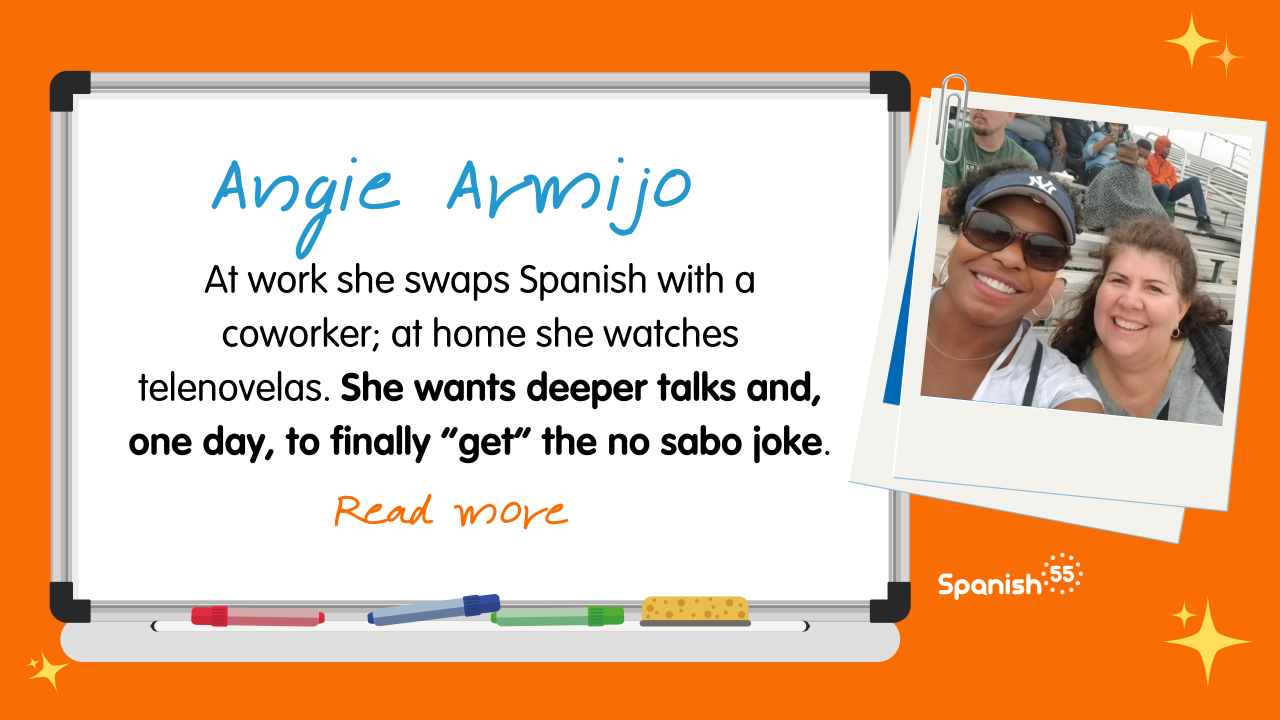
If you’d like to see how others describe that experience in their own words, you can read more here:
Read real Spanish55 student experiences and insights
Common Questions About Relearning Spanish After Growing Up Around It
1. Can you relearn Spanish as an adult if you grew up around it but never spoke it?
Yes. Many adults who grew up hearing Spanish already have strong listening comprehension, which becomes a major advantage. What’s typically missing is structured speaking practice in a supportive environment. With consistent, guided conversation, most heritage speakers can begin speaking comfortably much faster than true beginners.
2. Why is it hard to speak Spanish if I understand most of it?
Understanding and speaking are different skills. Many heritage speakers develop passive understanding but were never guided to actively use the language. Without regular speaking practice, hesitation and self-doubt build over time. The challenge is not knowledge, it’s confidence and real-time usage.
3. Is self-study (apps, YouTube, podcasts) enough to relearn Spanish?
Usually not. Self-study tools reinforce what you already understand but don’t create the conditions needed to speak. Heritage speakers typically need live, one-on-one conversation where they can practice responding, receive feedback, and build confidence in a low-pressure setting.
4. Do I need a Spanish tutor if I’m not a complete beginner?
Yes, and especially if you’re not a beginner. Heritage speakers benefit from personalized guidance because their starting point is unique. A one-on-one tutor can adapt to your level, focus on speaking, and help you close the gap between understanding and active communication.
5. What happens in a Spanish55 free trial lesson?
The Spanish55 Free Trial Lesson is a 55-minute, one-on-one session designed to help you speak, not just evaluate you. It includes a relaxed conversation about your background, a light, stress-free level assessment, and a short guided speaking experience. You also receive a clear, personalized learning path, without pressure or obligation.