Learning Spanish After 50: What a Good Tutor Should Do Differently
Last Updated: August 2026
Written by Abraham Arechiga-Arias
Cofounder at Spanish55

Almost every resource about learning Spanish after 50 starts by answering the same question:
Is it too late to learn Spanish?
For most people searching for help, that is not really the question anymore. You have probably already decided that you want to learn.
The more useful question is:
What actually changes when you learn Spanish in your 50s, 60s, or 70s, and what should a good tutor be doing differently because of it?
At Spanish55, we have worked one-on-one with adult Spanish learners in the United States since 2014, including a large number of students over 50.
One pattern has become very familiar to us.
Older students often introduce themselves by telling us their age. But once they start describing the actual problem they want help solving, age usually moves into the background.
Instead, we hear things like:
I can understand Spanish, but I can't respond quickly enough.
I've studied on and off for years, but I still freeze when someone speaks to me.
I know more Spanish than I'm able to use.
Those are not uniquely problems of older learners. We hear versions of them from adults at nearly every age.
Age is context. It is not the obstacle.
What does change is the person arriving at the lesson: their schedule, previous experiences, motivation, expectations, learning preferences, and sometimes practical considerations such as hearing or reading.
A good private Spanish tutor adapts to those things without lowering the goal.
The goal is still communication.
Sean, brand ambassador at Spanish55, covers the same question on video, with five of our students describing their own experience:
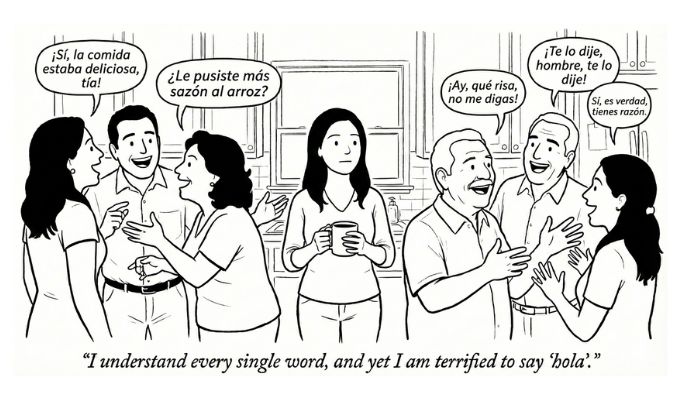
Understanding Spanish and Speaking Spanish Are Not the Same Skill
One of the most common situations we encounter is someone who has accumulated a surprising amount of Spanish without developing the ability to use it comfortably.
They may have studied Spanish in school.
They may have spent years using an app.
They listen to podcasts or watch television in Spanish.
They live somewhere where Spanish is spoken frequently.
They can often follow what people around them are saying.
Then someone turns to them and asks a question.
And they freeze.
This gap between comprehension and production is important because it can easily be misinterpreted as evidence that someone is "bad at languages" or that learning has become more difficult with age.
Often, the explanation is much simpler.
The learner has spent considerably more time receiving Spanish than producing it.
One Spanish55 student, Vicente, had spent decades playing soccer with Spanish speakers. He had heard Spanish on the field for years and understood quite a bit of what was being said.
But he rarely spoke it.
That experience had given him valuable exposure to Spanish. It had not automatically trained him to formulate his own thoughts and respond spontaneously.
Speaking requires speaking.
Vocabulary and grammar matter. Listening matters. Reading matters. But eventually the learner has to practice retrieving the language, putting ideas together, making mistakes, recovering from those mistakes, and continuing the conversation.
That is one of the reasons one-on-one instruction can be particularly useful.
There is nowhere to hide in a private lesson, but there is also no audience to impress.
It becomes a controlled place to practice doing the thing you ultimately want to be able to do in real life.
What Actually Changes When You Learn Spanish Later in Life?
There is no single profile of a Spanish learner over 50.
A 52-year-old physician learning to communicate with patients and a 72-year-old retiree preparing to spend several months a year in Mexico may have almost nothing in common educationally.
Treating them simply as "older learners" would tell a tutor very little.
But after working with adult students for more than a decade, we do see several circumstances appear frequently.
Your reason for learning is often very specific
Many students at this stage are not learning Spanish because it might be useful someday.
There is usually a person, place, responsibility, or experience attached to the goal.
A move is actually happening.
A trip has already been booked.
Spanish-speaking patients walk into the clinic every week.
Employees or coworkers speak Spanish.
A son or daughter married into a Spanish-speaking family.
Grandchildren are growing up bilingual.
Or the learner finally has the time to pursue something that has been important for years.
That specificity is extremely useful for a tutor.
Instead of asking only, "What grammar should we teach next?", the coach can ask a better question:
What does this person need to be able to do in Spanish?
The answer should influence the plan.
You may arrive with decades of unfinished Spanish
Many adults who describe themselves as beginners are not really starting from zero.
They may have taken Spanish in high school or college, studied independently, completed hundreds of app lessons, traveled extensively, or started and stopped several different programs.
A good tutor should not automatically send that person back to the beginning.
Part of the job is identifying what survived.
Perhaps the student recognizes a large vocabulary but cannot retrieve it quickly.
Perhaps they know grammatical rules but cannot use them during conversation.
Perhaps pronunciation is strong while sentence construction is weak.
Perhaps they have forgotten considerably less Spanish than they think.
This is something we see repeatedly in our own students and in the feedback people leave about their experience with Spanish55. Many come to us after trying other forms of Spanish study and describe the difference not as discovering a secret method, but as finally having instruction that responds to what they personally know, need, and struggle with.
That distinction matters.
The purpose of personalized instruction is not to make the lesson feel customized.
It is to make better educational decisions.
A Good Tutor Adapts the Day Without Losing the Plan
Personalized tutoring should not mean improvising aimlessly from one lesson to the next.
There should be a plan.
At the same time, a human being does not arrive at every lesson under identical conditions.
One of our students, Trish, a lawyer living in Denver, CO, talked about days when she came to her lesson mentally exhausted after a demanding workday.
On those days, sustained conversation could become unnecessarily difficult.
So she and her coach adjusted.
They might work through exercises, review previously covered material, or change the balance of the session.
The important part is what did not happen.
She did not have to skip the lesson.
And her coach did not abandon the larger learning plan.
They changed the shape of that particular session while continuing to move toward the same goal.
This is a simple example, but it illustrates something important about individual instruction.
Consistency and rigidity are not the same thing.
A good learning plan should survive a tiring Tuesday, a vacation, a demanding month at work, or a family obligation.
Adults have lives.
The educational system has to be designed accordingly.
Practical Adaptations Should Be Normal
Sometimes an adaptation has nothing to do with curriculum.
Hearing can matter.
Reading can matter.
Technology can matter.
The speed at which information is presented can matter.
Our student Joel Dermott, a public health administrator in rural Missouri has spoken publicly about hearing challenges and difficulty reading while learning Spanish. Watching the person speaking and reading lips became part of how he communicated in Spanish.
That did not change the objective.
It changed the conditions under which he could pursue it effectively.
This distinction is important because older learners are sometimes given advice that unintentionally lowers expectations.
That is not what useful adaptation looks like.
The tutor's question should not be:
"How much Spanish can someone this age realistically handle?"
It should be:
"What does this particular student need in order to learn and communicate effectively?"
Then the tutor adjusts accordingly.
Knowing When to Correct Someone Is Part of Teaching
One-on-one instruction also creates a decision that software handles poorly: when to interrupt.
Imagine trying to tell a story in Spanish while someone stops you after every grammatical mistake.
You might leave with a long list of corrections and very little experience actually communicating.
At the opposite extreme, a tutor who never corrects anything may allow recurring mistakes to become habits.
Good instruction sits somewhere between those two approaches.
Sometimes the learner needs an immediate correction.
Sometimes they need three more seconds to find the word themselves.
Sometimes the mistake can wait until they finish the thought.
And sometimes the most useful thing the tutor can do is allow an imperfect sentence to succeed because communication happened.
The timing of feedback becomes especially important for students who have spent years studying Spanish but remain hesitant to speak it.
The objective is not simply correctness.
It is increasingly accurate, confident, spontaneous communication.
Repeating Something Is Not Going Backward
Traditional courses create a very strong idea of progress.
Chapter 4 comes after Chapter 3.
Finishing Chapter 4 means you are progressing.
Going back to Chapter 3 feels like failure.
Language learning does not always work that neatly.
One Spanish55 student, Ardy, worked through an entire set of material on the Spanish subjunctive with her coach.
Then she asked to go through it again.
So they did.
There was nothing wrong with the first round.
She simply wanted more practice before moving forward.
That is an educational decision that becomes much easier when the curriculum serves the learner rather than the other way around.
Covering material is not the same as owning it.
Sometimes progress means learning something new.
Sometimes progress means returning to something familiar until it becomes easier to use.
Accountability Is Different When Another Person Is Involved
Apps have become very good at encouraging consistency.
They send reminders.
They count streaks.
They congratulate you for returning.
Those tools can be useful.
But a streak and a relationship create different kinds of accountability.
A tutor knows what you were working on last week.
They know what you said you wanted to accomplish.
They know where you hesitated during the last lesson.
They notice when something that was difficult a month ago has become easier.
And they notice when you disappear.
That human continuity is one of the themes that our students share time and time again. Students regularly mention patience, comfort, confidence, personalization, and the relationship they develop with their coach.
Those are not merely customer-service benefits.
They affect learning.
Speaking another language requires being willing to sound imperfect for a while. A productive relationship with a tutor creates a place where that can happen repeatedly without embarrassment.
How Long Does It Take to Become Conversational in Spanish?
Language-learning timelines are difficult because people mean very different things when they say "learn Spanish."
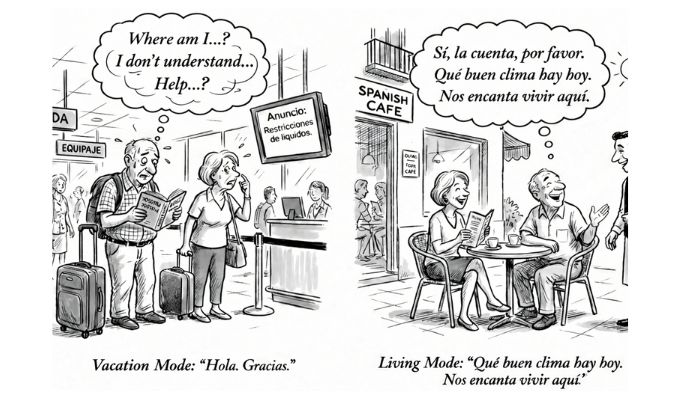
Ordering at a restaurant is one level of ability.
Talking comfortably with a friend for an hour is another.
Working professionally in Spanish is another.
Starting level, previous exposure, frequency of lessons, independent practice, and opportunities to use the language all affect progress.
But learners deserve something more useful than being told that "everyone is different."
With consistent practice, most adults can begin reaching basic conversational ability somewhere around four to six months into serious study.
Real comfort usually takes longer.
The point where you stop rehearsing every sentence before saying it, recover more naturally from mistakes, and begin participating rather than merely responding can take closer to one to two years.
Those are practical expectations, not guarantees.
And they do not suddenly change because someone turned 60.
Frequency and quality of practice matter much more.
Progress Often Feels Smaller Than It Actually Is
One reason adults abandon Spanish is that progress can be difficult to perceive while it is happening.
You study for several weeks and still make mistakes.
You learn more vocabulary and still forget ordinary words.
You have a good conversation on Monday and struggle on Thursday.
One of our students, Brittany, described the experience as a period where it feels like something is not happening until suddenly Spanish just clicks.
We have seen versions of that pattern many times, thousands of times here at Spanish55.
This is one of the advantages of working with a tutor who has observed other learners over a long period.
The student experiences every frustrating day individually but the tutor has a wider frame of reference.
A qualified Spanish tutor can recognize that someone who feels stuck is actually speaking longer, hesitating less, using more complicated sentences, or recovering more quickly after making a mistake.
Real progress is often quieter than "fluency."
It looks like less tension.
Fewer moments of freezing.
Less translating.
More willingness to try.
A conversation that lasts five minutes longer than it used to.
Eventually those small changes accumulate into something much more noticeable.
So What Should You Look for in a Spanish Tutor?
If you are learning Spanish after 50, you do not necessarily need a tutor who specializes in teaching "older people."
You need a tutor who is good at teaching you.
Look for someone who wants to understand your reason for learning before prescribing a program.
Someone who can identify the difference between what you recognize and what you can actually produce.
Someone who adjusts the pace without lowering expectations.
Someone who knows when to correct you and when to let the conversation continue.
Someone willing to revisit material instead of racing through a curriculum.
And someone capable of thinking beyond the next lesson.
At Spanish55, our approach begins by understanding the student's goal and helping them understand the path required to reach it. From there, the coach and student work consistently on the communicative skills needed to move toward greater fluency.
The tutor is central to that process, but they are not working alone. Our coaches are supported by an academic and Student Success structure designed to keep the larger learning experience on track.
That model has evolved through more than a decade of working exclusively with one-on-one Spanish learners.
And perhaps the most important thing those years have taught us is this:
The better we understand the individual learner, the better educational decisions we can make.
That is true at 35.
It is true at 55.
And it is true at 75.
Your age belongs in the conversation because your life belongs in the conversation.
But it does not have to define what you are capable of doing with Spanish.
If you feel ready to give Spanish lessons a try, check out this video: What to Look for in an Online Spanish Tutor (4 Things to Check Before You Book a Lesson)
See How Other Adult Learners Have Experienced It
Several of the students mentioned in this article shared their experiences through Conquering Spanish, our interview series featuring Spanish55 students speaking candidly about learning the language, the difficulties they encountered, and what eventually helped.
If you are considering private Spanish lessons and want to understand what the process might look like for you, the first step at Spanish55 is a complimentary 55-minute video consultation.
A Spanish coach will learn about your goals, evaluate your current Spanish, and help you understand a realistic path forward. This is not a sales pitch, it is a fun and informative 55-minute Zoom meeting.
Schedule your free trial lesson here
A Few Common Questions
Can you learn Spanish at 60 or 70?
Yes. Adults continue learning languages throughout life. The teaching may need to account for the individual student's goals, schedule, previous experience, learning preferences, hearing, or other practical considerations, but age alone does not determine whether someone can become conversational.
Why can I understand Spanish but not speak it?
Comprehension and production are different skills. Many learners accumulate years of Spanish input without getting comparable practice retrieving words, forming sentences, and responding spontaneously. More deliberate speaking practice is usually necessary to close that gap.
Are private Spanish lessons better than apps after 50?
They serve different purposes. Apps can be useful for vocabulary, repetition, and additional exposure. A private tutor can respond to your actual speech, adjust corrections and pacing, identify individual weaknesses, change a lesson when needed, and maintain a longer-term plan. The two can complement each other.
How long does it take to become conversational?
With consistent practice, basic conversational ability can often begin developing within four to six months. Genuine conversational comfort typically takes closer to one to two years. Starting level, frequency of practice, and the amount of real speaking you do can significantly affect that timeline.